
Profit is Freedom
Recently we were invited to speak with a group of progressive veterinary business owners. Unusually, they gave us free reign to choose the topic. Considering the single-most important message we ought to impart, we knew exactly what we wanted to speak about. Profit.
Not just making the most money you can at any cost, but ensuring that your business delivers financially so that it sustainably supports not only you and your family, but also your team and your local community*.
Now you might think that profit is an unusual focus for Onswitch. After all, our own mission statement centres around patient outcomes and client care:
“Driving meaningful change with a customer-centred approach, ensuring patients receive the best care.”
The fact is, only when a business is consistently delivering great service can it ever hope to return profit. If customers can’t get appointments when they need them, feel unvalued or ripped off, or don’t like the way they are treated when they visit, they simply won’t return. And they’ll tell friends and family not to use you either. Conversely, when you provide pets and horses with the best care and treat their owners with respect and understanding, your phones and online booking systems will always be busy.
Of course, seeing lots of patients does not automatically mean the money will come rolling in. If your overheads are higher than your income, there won’t be profit. If churn within your team is high and you routinely rely on locums, your people costs could be unsustainable. If your fees don’t cover costs, or your caseload mix is unbalanced, then even the most packed consult calendar won’t save your business in the long term.
Profit is power
Profit is essential for every business; it ensures certainty and sustainability. Without profit, veterinary practices can be vulnerable to unwanted acquisition attempts, are left unable to invest in equipment, teams and training, and thus will ultimately fail to attract and retain great people. Triggering a slow, painful spiral towards closure.
Generating profit from your practice allows you to do amazing things. The jobs you provide and the wages you pay bring stability to those you employ. The taxes you pay fund our schools, hospitals and roads, contributing to the £1 trillion that the UK government receives every year, primarily from income tax, NICs and VAT.
Your team need you to be profitable.
Your community needs you to be profitable.
You need to be profitable.
But profit is a lag indicator, revenue follows activity. Profit will fall if client numbers go down significantly, if multiple team members leave or when business processes are inefficient. Tracking profit alone is not enough of a measure of success, because when you see it falling, things have been going wrong for a while. That’s why it’s crucial to regularly measure Key Performance Indicators across your business, so you can see immediately where things are happening that will affect profitability in the coming weeks and months. And of course, when you know about them, you can act to put them right.
Take control with a Balanced Scorecard
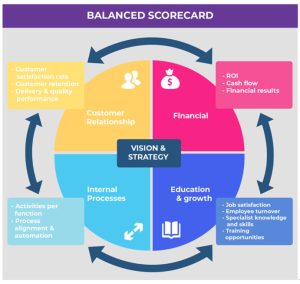
Here at Onswitch we are big fans of a Balanced Scorecard approach to business management. The concept was first introduced by Robert Kaplan and David Norton in 2005, as a means of standardising the measurement and appraisal of business performance. Using this structured approach in monthly management meetings will ensure that deliberate and intentional time, focus and resources are allocated to reviewing and managing each of four vital areas of your business, maximising profit and giving you the freedom to make active choices to grow your practice.
There are four quadrants to the model, each containing Key Performance Indicators that can be measured and tracked over time, highlighting where focus may be needed:
Clients – incoming call volumes, new client registrations, word of mouth recommendations, complaint levels, Net Promoter Scores
· Team – absenteeism, staff turnover, sick rates, levels of engagement
· Operational effectiveness – practice layout, routine recall protocols, diary management, stock holding, rota design
· Finance – areas of overspend, poor profitability, over reliance on locums etc.
What you measure is what you get
Using the Balanced Scorecard in your periodic directors’ meetings, will inform how processes can be made leaner, highlight where people can work smarter and identify where the client experience can be further improved. This allows you to make decisions based on evidence, rather than gut feel. It ensures you’re always seeing the full picture and not being distracted away from spiralling people costs and falling client numbers by a temporary boost in turnover in puppy season.
Good medicine is good business.
Focus brings profit.
Profit is freedom.
* If you’re interested in reading more about the concept of sustainable economics, balancing growth with the provision of a just society where we can all thrive, then ‘Doughnut Economics’ by Kate Raworth, is a highly recommended read.
And if you’d like us to spend time with your team, either at leadership level or at the reception desk, Onswitch offer a wide range of services from a Monthly Support Plan to our acclaimed customer care workshops. You can even have Alison acting as a non-executive Director, guiding your business on a regular, or ad hoc basis. Whatever you think you might need, we can help – why not have a chat to one of our team here, or give us a call on 01476 565343.


